Showing posts with label geek fest. Show all posts

Saturday, January 2, 2010

The Biggie Circle Scarf


I have been admiring the circle scarfs that seem to be so popular, especially the moebius strip type that, technically speaking, have only one side. Alas, my version has two sides but it is very easy to make and works up fast (would you believe less than an hour?) when you use a giant hook (size Q) and 5-6 strands of yarns at a time.

Pattern available in my etsy shop.

Thursday, November 12, 2009

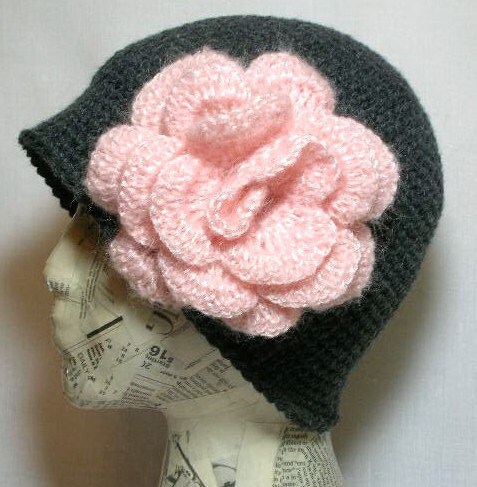
No Gauge Custom Cloche


I have been in a hat/cap/beanie making mood lately. I have no idea why since I live in Texas and it is the rare day that Texans need to keep their heads warm. But in any case, here's my 'make your own custom cloche' instructions no matter the head size or the yarn/hook combo. Works for little girls, works for big girls.

First you need to measure the circumference of the head in question. For most adults you can figure 21" if you don't want to go to the trouble of digging out the tape measure. Now we all remember that the circumference of a circle equals 2 times pi times the radius. (Where the heck is the pi symbol on this keyboard?) Moving everything around through the magic of algebra we have

diameter = circumference/3.14

The diameter is the important number here. In our example of the circumference being 21", we have a diameter of approximately 6.7". Now you crochet in the round in a continuous spiral, starting with 6 SC in the first round and increasing by 6 each time around. In other words:

ROUND 1: CH 2. SC 6 in the second chain from the hook.
ROUND 2: (2 SC in the next stitch) all the way around for a total of 12
ROUND 3: (SC 1, 2SC in the next stitch) all the way around for a total of 18
ROUND 4: (SC 2, 2SC in the next stitch) all the way around for a total of 24
ROUND 5: (SC 3, 2SC in the next stitch) all the way around for a total of 30
.... and so on....

until the diameter is close to what you calculated (6.7" in our example.) Doesn't have to be exact, just close. Now for the easy part. However many rounds you have made so far, make twice that many without increasing (one SC in each stitch from now on.) If you had 8 rounds now add an additional 16. Finish off and weave in loose ends.

In summary:
1. figure out the diameter you need (circumference of the head divided by 3.14.)
2. crochet in the round in a spiral increasing by 6 each round til you reach that diameter.
3. Now do twice as many rounds as you have already done, but only do 1 SC in each stitch.
4. Finish off and weave in loose ends.

And if you want it to be a beanie, just do fewer rounds at the end.

Saturday, March 28, 2009

Non-Euclidean Geometry meets Crochet


Ever heard of Hyperbolic Geometry? Apparently it is the geometric opposite of the sphere. On a sphere, the surface curves in on itself and is closed. On a hyperbolic plane the surface curves away from itself at every point. In other words....
In Euclidean geometry, as a circle gets larger, the length of the circumference increases linearly. But with a hyperbolic plane, we're talking EXPONENTIAL increases. Got that?
Oddly enough, the concept of a hyperbolic plane can be physically modeled using crochet.

Yes, you can impress your family and friends by making your own hyperbolic surface! All you do is increase the number of stitches in each successive row or round of a crochet project. That's it. Here's how to make a 'pseudosphere' (like the one I made pictured above):

1. CH 2. SC 6 in the second chain from the hook (6 SC total).
2. SC 2 in each stitch all the way around (12 SC total).
*BTW, I like to crochet in a spiral and not worry about ending rounds and starting another. So just keep going with step 3 - don't worry about making a SL ST to the last stitch in the round and all that stuff.
3. SC 2 in each stitch all the way around (24 SC total).
4. SC 2 in each stitch all the way around (48 SC total).
5. SC 2 in each stitch all the way around (96 SC total).
I think I stopped after step 5 but feel free to keep going!

You'll get a kinesthetic feel for what 'expanding exponentially' REALLY means. Early rounds go quickly, but each successive round takes longer and longer (and also eats up exponentially increasing amounts of yarn.)

If you want to learn a little more about the mathematics involved, check out this article or just google 'hyperbolic crochet.'